

TERM LIFE INSURANCE
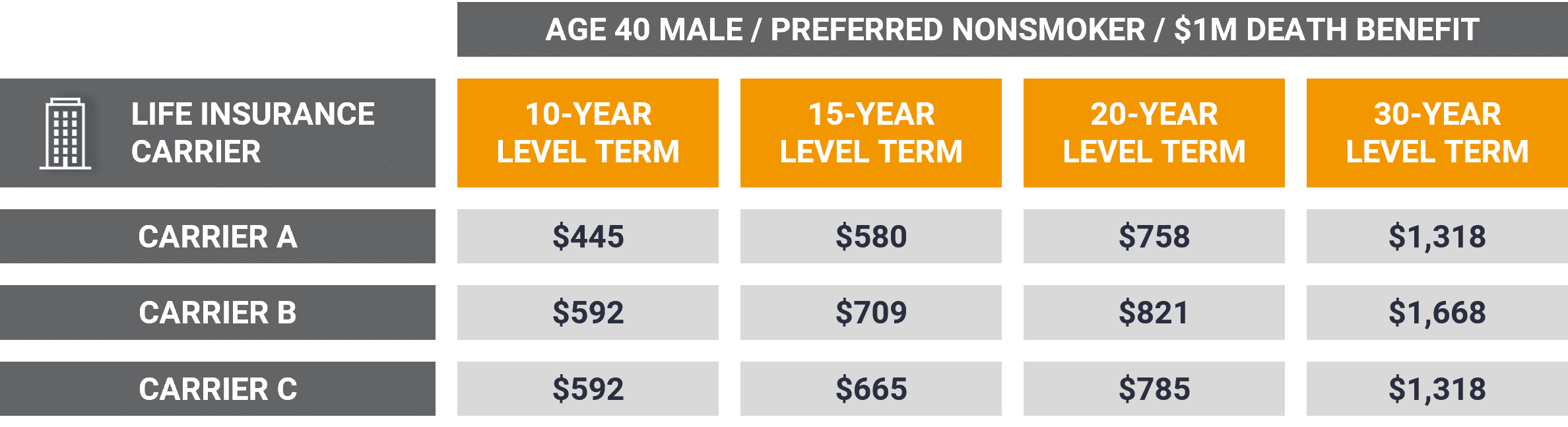
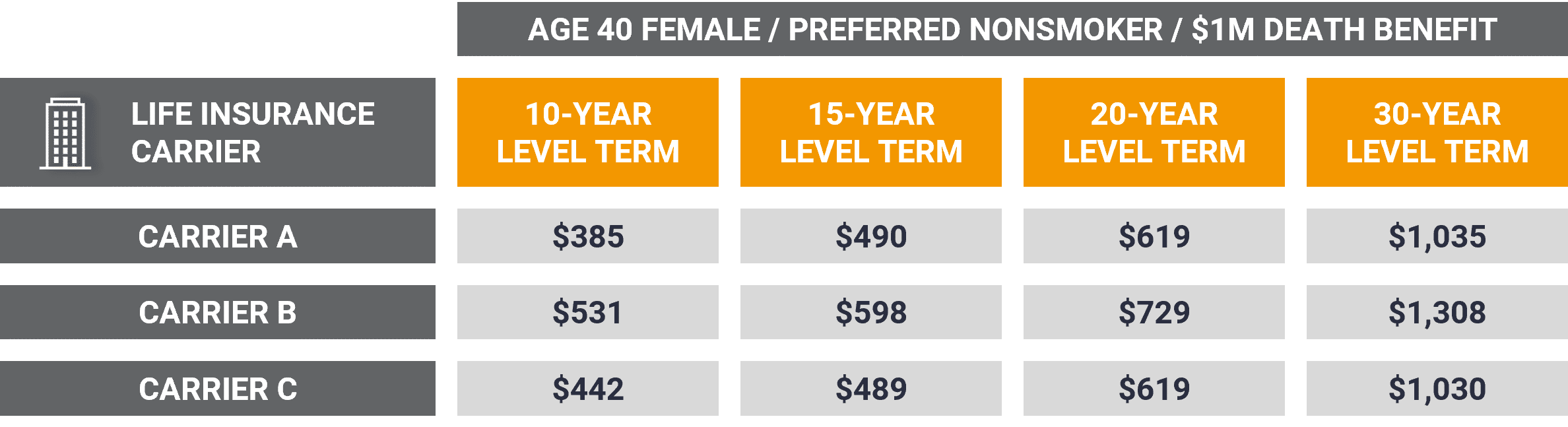
Term life insurance is one of the simplest types of life insurance products available. It is widely used by families who have a desire to provide family protection over a specific period of time. As with all fully underwritten life insurance coverage, premiums are based on the age and health of the individual at the time they apply for insurance coverage. When coverage is applied for, the policy owner decides the length of the coverage. The most common term life insurance policies are:- 10-Year Term
- 15-Year Term
- 20-Year Term
- 30-Year Term
Term Life Insurance Example
Assumptions:- 40-Year-Old Male / Preferred Nonsmoker Health Class
- 40-Year-Old Female / Preferred Nonsmoker Health Class
- $1,000,000 Death Benefit on Each Individual
- Premiums are Paid Annually
Term Life Insurance Conversion
Most term life insurance policies allow the policy owner to convert their coverage to permanent life insurance. The conversion has to be to a permanent policy issued by the same company the term life insurance is with. The benefit of a conversion is it does not require you to go through the underwriting process again. They will issue the permanent policy using the health class rating you received when the term life insurance policy was originally issued. This can be beneficial for an insured who has had changes to their health. Term life insurance conversions can only be done during the term period or prior to a certain age. Each term life insurance policy will include the maximum conversion age in the policy contract. It will typically be age 65, 70, or 75. If you purchase a 30-year term policy at age 50 and you can convert up to age 75, you will only be able to convert the coverage during the first 25-policy years. Most carriers offer a term insurance conversion, but not all. Some carriers will limit what permanent product you can convert to. The pricing will likely be much higher than their other permanent life insurance products.PERMANENT LIFE INSURANCE
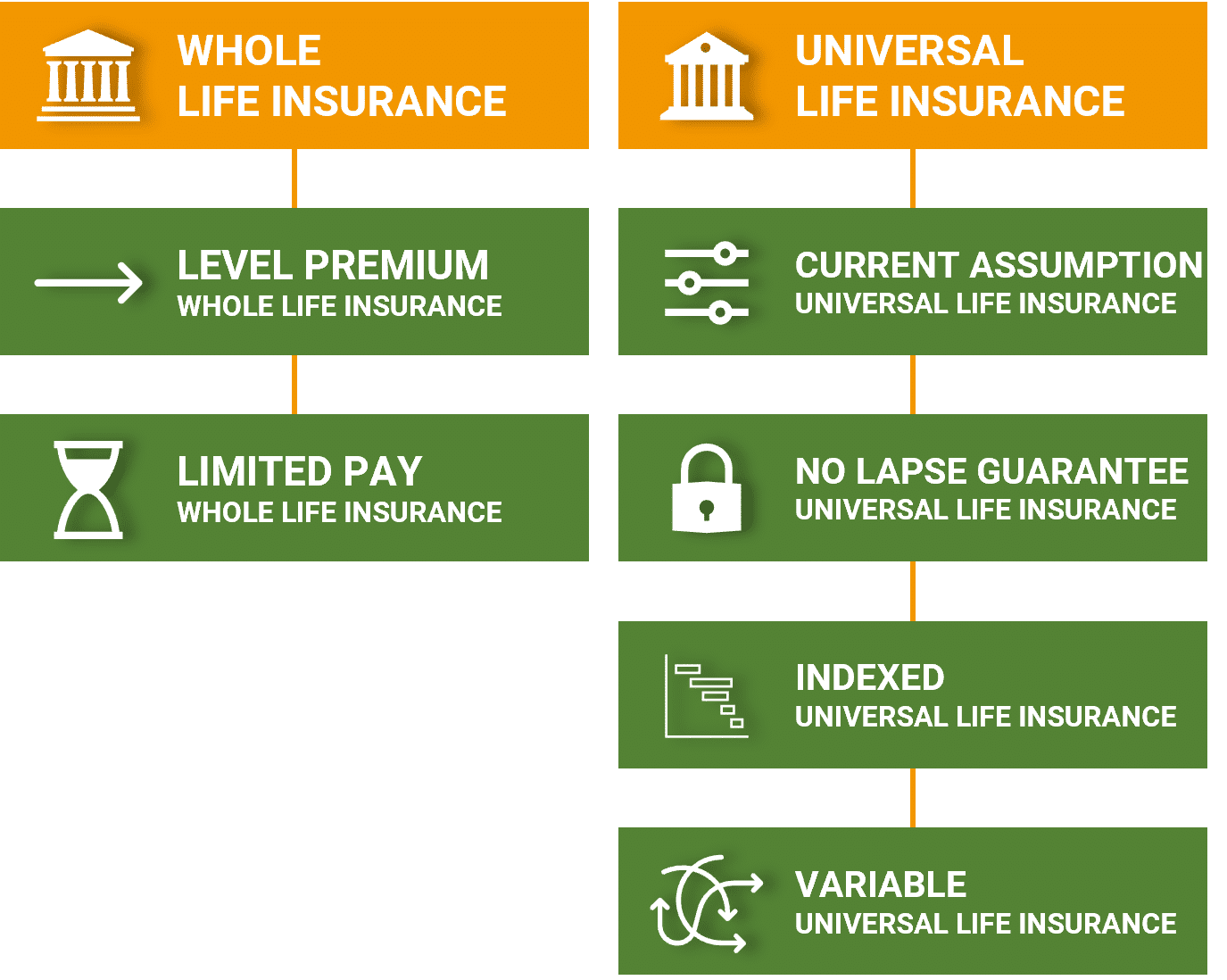
Permanent life insurance is meant to provide coverage for the life of the insured. A permanent life insurance policy is a type of life insurance that is more expensive than term life insurance. Unlike term insurance, permanent life insurance allows the policy to build cash value (or equity) within the policy. Permanent life insurance policies come in the form of two types of life insurance: Whole Life Insurance and Universal Life Insurance.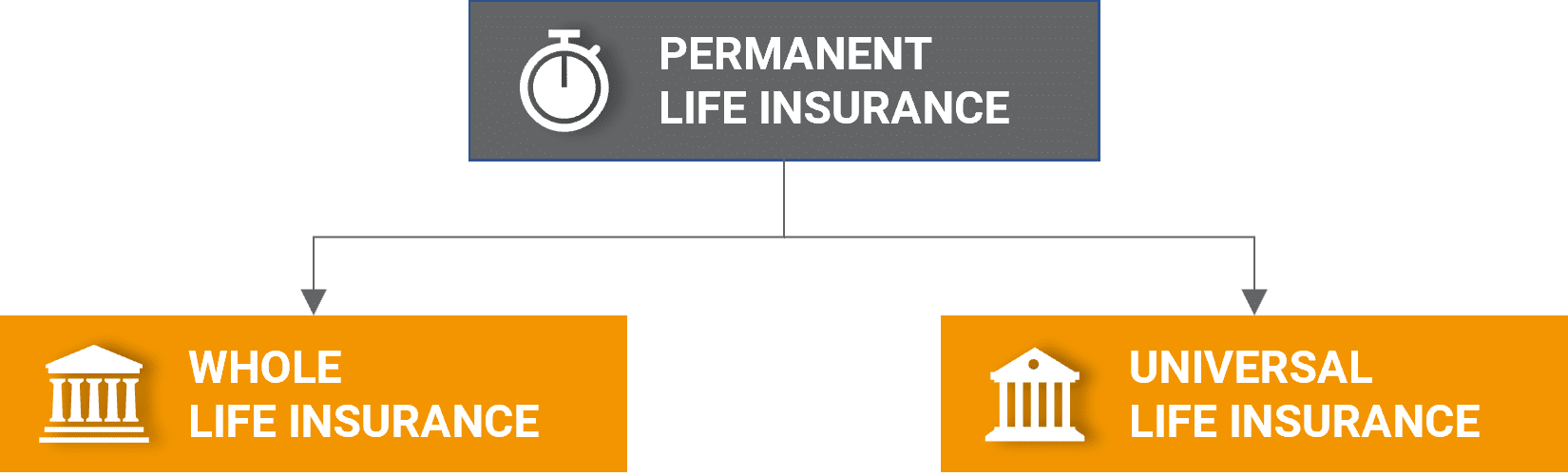
Under these subcategories is also a number of additional subcategories.
WHOLE LIFE INSURANCE
Whole life insurance is a type of life insurance that provides guaranteed protection and premiums over the insured’s lifetime, as long as premiums are paid. A whole life policy also builds cash value. The guarantees of a whole life insurance policy are based on guaranteed dividend rates and guaranteed mortality charges. Whole life insurance dividends are a portion of the carrier’s profits that are paid to policy owners. Current dividend rates may be higher than the guaranteed dividend rate, providing additional benefits to policy owners. A whole life insurance policy with guaranteed dividends will tend to have higher premiums. While a whole life insurance policy assuming a current dividend rate may have lower premiums. Additional benefits may include Paid-Up Additions (PUAs). Paid-Up Additions are added to the base death benefit. Dividends may also be used to offset future premium payments or distributed directly to the policy owner. Premium payments for a whole life insurance policy offer little flexibility. Missed premiums can result in policy loans that can have an adverse outcome on policy performance.LEVEL PREMIUM WHOLE LIFE INSURANCE
Level Premium (or Level Pay) Whole Life Insurance is the most common form of whole life insurance. A Level Pay Whole Life Insurance policy requires the policy owner to pay premiums for the insured’s lifetime. This type of policy will typically have guaranteed and non-guaranteed features. Guaranteed performance is based on the guaranteed dividend rate and guaranteed mortality. The guaranteed dividend rate is the minimum dividend rate a carrier is obligated to pay. The guaranteed mortality is the maximum amount a carrier can charge for expenses. Non-guaranteed rates are based on a carrier’s current or actual dividend rate. The non-guaranteed rate can never be less than the guaranteed rate.Level Premium Whole Life Insurance Example
The following example assumes the insured is a 40-year-old male in a preferred nonsmoker health class.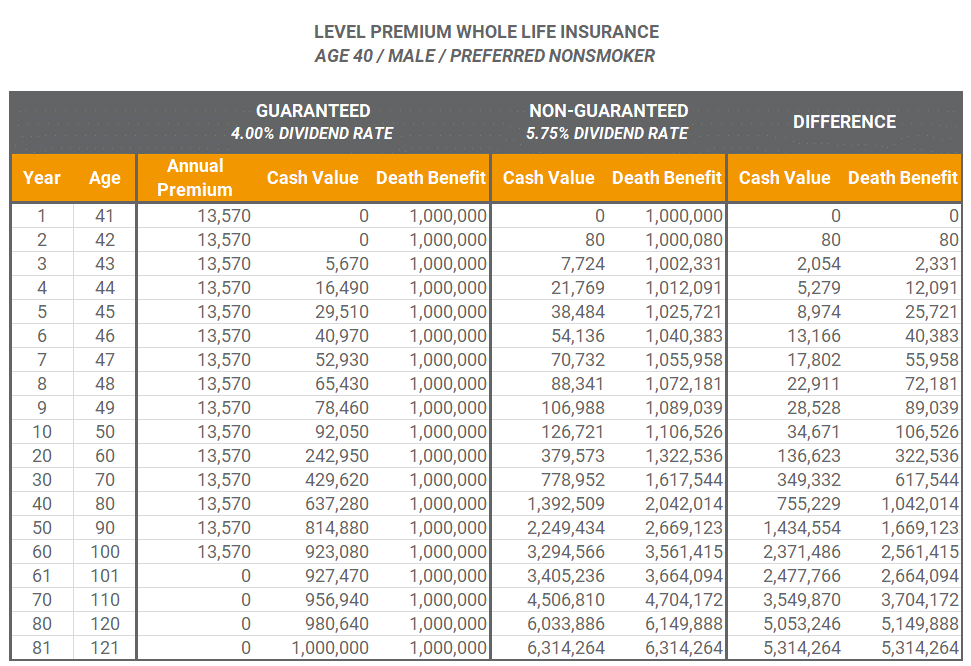
What If The Non-Guaranteed Dividend Rate Goes Down?
If the Non-Guaranteed Dividend Rate drops it will only affect the Non-Guaranteed Cash Value and Death Benefit. The Guaranteed values will never change provided premium payments continue to be made on time. The following example assumes an Alternative Non-Guaranteed Dividend Rate of 5-percent.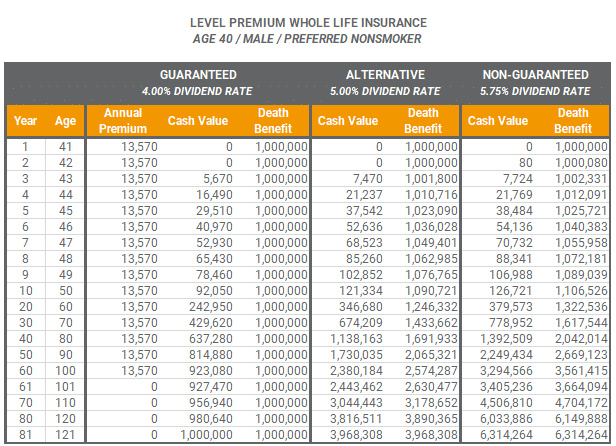
LIMITED PAY WHOLE LIFE INSURANCE
Limited pay whole life insurance functions the same way as Level Pay Whole Life Insurance. The biggest difference is premiums are paid over a shorter period of time. Most policies offering a limited pay require you to do this at policy inception. Products offering a limited pay usually require you to do it as a:- One-time lump sum payment
- Over a 10-Year Period (or 10-Pay)
- To a Certain Age such as Age 65
Limited Pay Whole Life Insurance Example
Here is an example of the same 40-year-old male from our prior example. The only difference is we are going to pay premiums for 10-years and not for the insured’s entire life.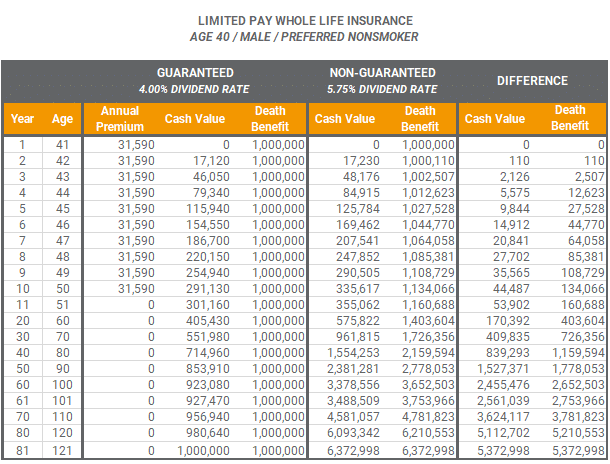
UNIVERSAL LIFE INSURANCE
Universal life insurance allows you to build cash value (just like a whole life insurance policy) and includes flexible premium payments and death benefits. One of the biggest differences between whole life and universal life is flexible premium payments. You are able to control the frequency and amount of premium payments. The other difference is policy cash values are based on a crediting rate and not a dividend rate. How the crediting rate is determined will vary based on the type of universal life insurance policy you are using. The amount and timing of premium payments will directly affect a policy’s cash value and the ability to maintain coverage in the future. A policy with low cash values will not last long without additional premiums. There are four primary types of universal life insurance policies:- Current Assumption Universal Life Insurance
- No Lapse Guarantee Universal Life Insurance
- Indexed Universal Life Insurance
- Variable Universal Life Insurance
CURRENT ASSUMPTION UNIVERSAL LIFE INSURANCE
Current Assumption Universal Life Insurance offers death benefit and cash value accumulation based on both guaranteed and current assumptions. It offers flexible premiums and cash value growth. Current assumption universal life insurance policies (similar to whole life) have four factors that affect policy performance. The four factors are as follows:- Guaranteed Crediting Rate
- Current Crediting Rate
- Guaranteed Mortality Costs
- Current Mortality Costs
Current Assumption Universal Life Insurance Example
The following example assumes the same 40-year-old male from our prior examples. In this scenario, we are solving for the premium to secure $1M of coverage using Current Assumptions.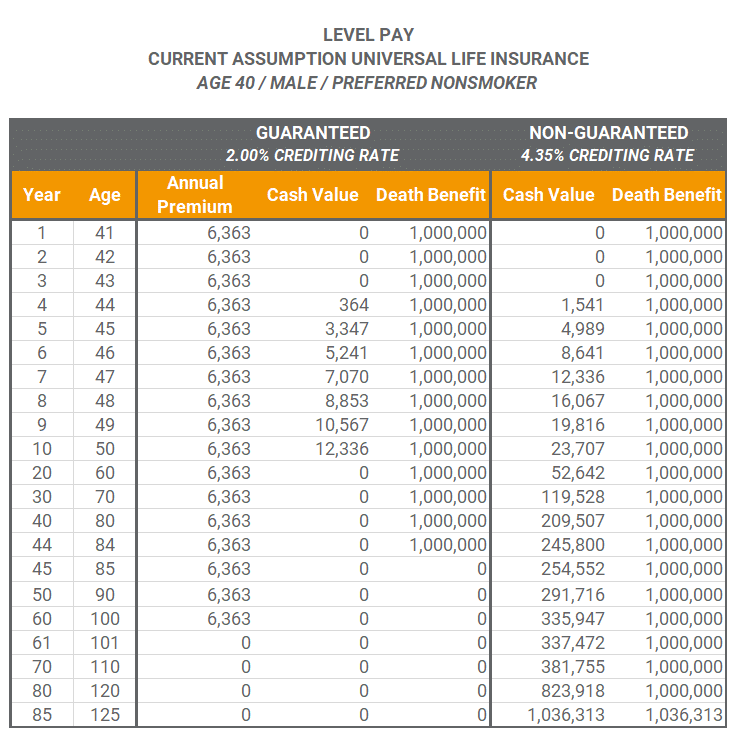
- Reduce Annual Premium Payments, or
- Stop Making Premium Payments at some Point in the Future
- Increase premiums,
- Reduce the length of time the coverage lasts
- Lower the death benefit, or
- A combination of the three.
What If The Non-Guaranteed Crediting Rate Goes Down?
In this example, we are assuming the Non-Guaranteed Crediting Rate drops from 4.35-percent to 3.5-percent. We are also assuming the policy owner does not make any changes to the annual premium.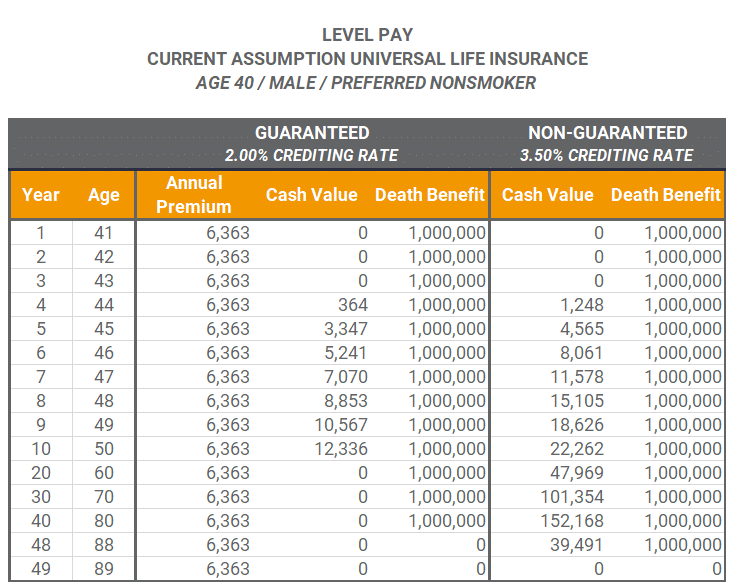
NO LAPSE GUARANTEE UNIVERSAL LIFE INSURANCE
No Lapse Guarantee (NLG) Universal Life Insurance provides guaranteed universal life insurance coverage for the life of the insured. Regardless of if a carrier adjusts crediting rates or mortality costs, the premium and death benefit are guaranteed. The policy owner can choose to make premium payments over the life of the policy or over a shorter period of time. As long as the carrier receives premium payments on time, premiums will never change. No Lapse Guarantee Universal Life insurance policy generally offers lower cash value in comparison to other permanent life insurance. In exchange, the policy has very few moving parts. No Lapse Guarantee Universal Life insurance works more like a permanent term life insurance policy.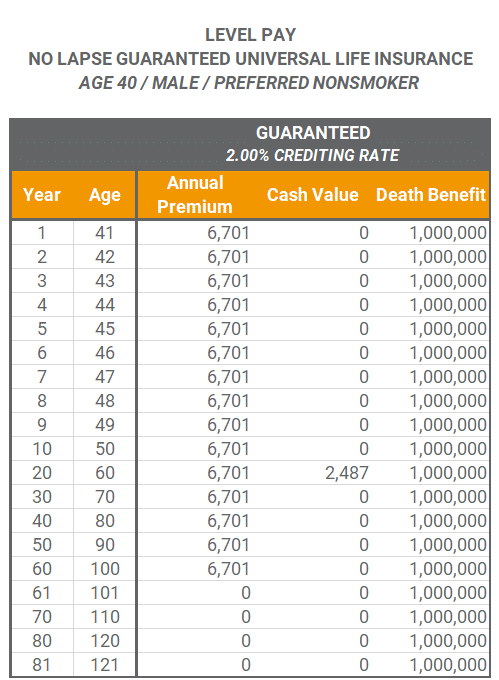
INDEXED UNIVERSAL LIFE INSURANCE
Indexed Universal Life Insurance is similar to a Current Assumption Universal Life policy. It provides a death benefit and cash accumulation. With an Indexed Universal Life Insurance policy, the policy owner has the option of placing the cash value in the Fixed Account or an Indexed Account. The Fixed Account will credit a fixed crediting rate that includes a minimum Guaranteed Crediting Rate. The Indexed Account allows policy cash values to be credited based on how the chosen index performs. Index Accounts are placed in an Index Segment. The carrier will record the beginning and ending value of an Index Segment in order to determine the Segment Growth Rate. Index Segment are usually calculated over the course of 1-year, but can also occur over a 5-year period. Indexed Universal Life Insurance is unique because when index returns are negative, the policy is credited the Floor. The Floor is a Guaranteed Minimum Crediting Rate. Most Index Universal Life policies offer a Floor of 0-percent or 1-percent. The Index Growth will be subject to a Cap Rate, Participation Rate, and/or Spread. These rates are what ultimately determine the cash value crediting rate.Cap Rates
Cap Rates are the maximum crediting rate an Indexed Account can be credited. For instance, assuming an Index Segment has a Cap Rate of 12-percent and the Index Account returns 15-percent. The portion of the policy allocated to this Index Account will be credited the Cap Rate of 12-percent. If the Index Account returns 6-percent, the policy cash value will receive a credit of 6-percent. If the Index Account returns -28 percent, the policy will receive the minimum Floor crediting rate of 0-percent.Participation Rates
Participation Rates are a percentage that is applied to the Segment Growth Rate. In the example above, we assumed a 100-percent Participation Rate. However, some Index Segments may have a 150-percent Participation Rate. The Segment Growth Rate is then multiplied by the Participation Rate to determine the amount the Index Account is credited. For instance, assuming a Segment Growth Rate of 6-percent and a Participation Rate of 150-percent would result in the Index Account being credited 9-percent (6% Segment Growth Rate TIMES 150% Participation Rate). Now, let us assume Segment Growth Rate of 10-percent, Participation Rate of 150-percent, and Cap Rate of 12-percent. The Segment Growth Rate is multiplied by the Participation Rate resulting in a Crediting Rate of 15-percent. However, there is a Cap Rate of 12-percent. Because of this, the Index Account will be credited 12-percent, not 15-percent.Spread
The spread is usually reserved for Index Accounts that do not have a Cap Rate. The Spread is a percentage return (or minimum threshold) the Index Segment must return before it is credited. For instance, assuming a 5-percent Spread and 22-percent Segment Growth Rate would result in an Index Crediting Rate of 17-percent (22-percent Segment Growth Rate LESS 5-percent Spread). If the Segment Growth Rate is 3-percent, the Index Account will be credited the Floor of 0-percent.Indexed Universal Life Insurance Example
In this example, we are assuming policy cash values are in the Index Account. The Index Account is based on the S&P 500 1-Year Point-to-Point Index Segment. The Index Segment has a 100-percent Participation Rate and 9.00-percent Cap Rate. We have assumed an average annual indexed crediting rate of 5.50-percent.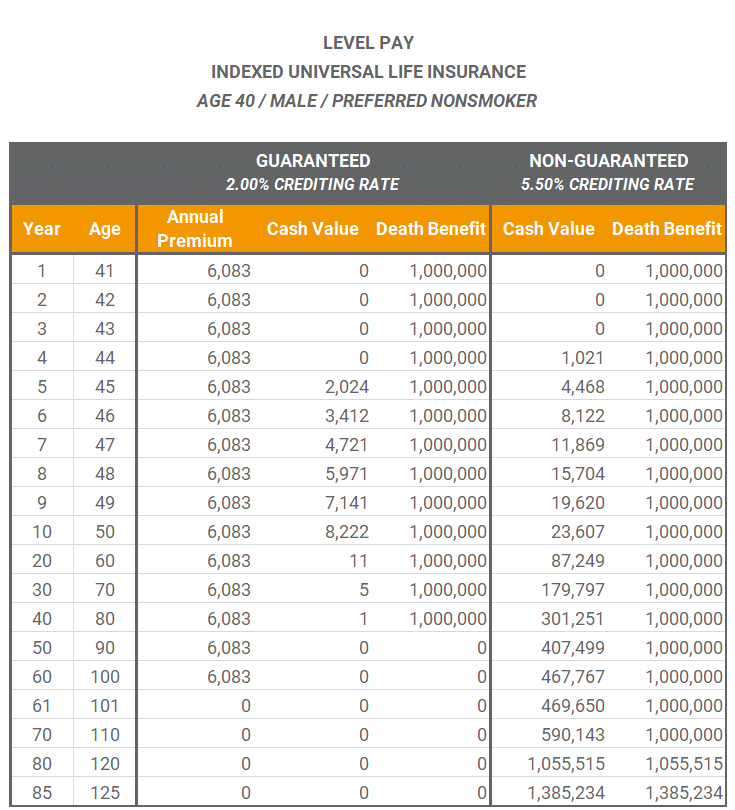
VARIABLE UNIVERSAL LIFE INSURANCE
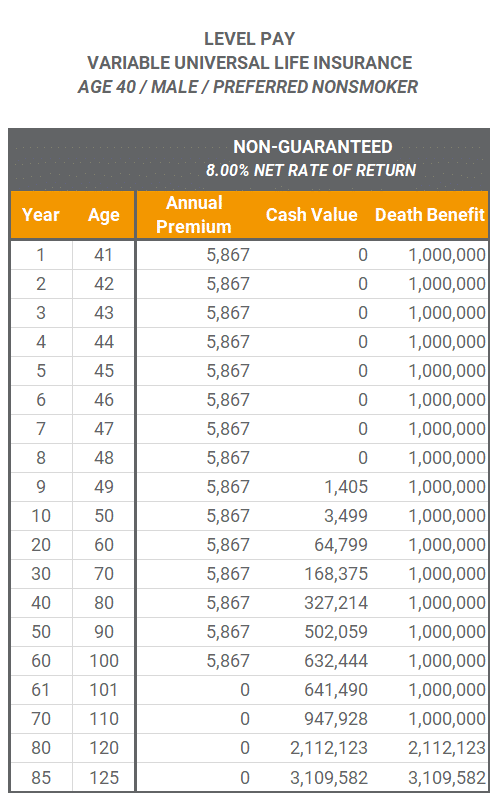
Again, Variable Universal Life Insurance is similar to Current Assumption Universal Life Insurance. Both types of policies are based on current and guaranteed assumptions and offer premium flexibility. The cash value can be placed in a fixed account or invested across a number of sub-accounts. Sub-accounts are similar to mutual funds. Most Variable Universal Life Insurance policies offer a range of sub-accounts to policy owners. Sub-accounts will be comprised of stocks, bonds, or money market accounts. Each sub-account will have its own area of focus such as growth, value, emerging markets, etc. The policy owner can allocate the cash value across multiple sub-accounts in order to diversify policy performance. Sub-accounts will also include management fees in addition to policy expenses and charges. Sub-accounts are subject to market risk and market returns. Unlike Indexed Universal Life Insurance, you can experience negative returns in a Variable Universal Life Insurance policy.Variable Universal Life Insurance Example
This example assumes the cash value is fully invested in the market. We are using an assumed 8-percent return to project policy performance.